
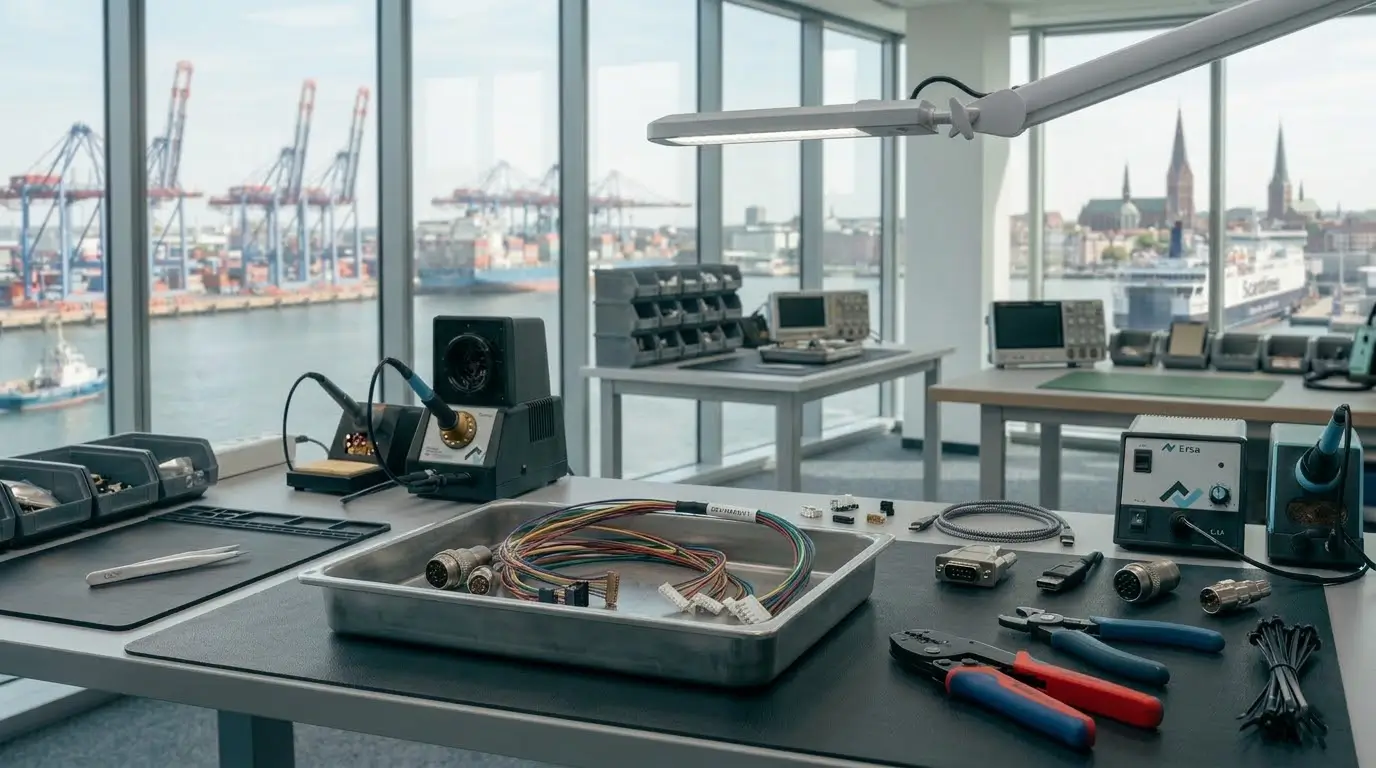
Custom Cable Harnesses – Engineered in Rostock, Manufactured at Our Premium Partner
We engineer and plan your cable harnesses in Rostock – proven on our own GPS trackers with Fakra connectors – and manufacture them via our premium partner in China. Concept in 2–3 working days, first prototype in 2–4 weeks. Ideal for small series, with component sourcing from a single source.
In brief
How does Autoskope produce cable harnesses – and from what quantity?
Autoskope engineers and plans custom cable harnesses and wire sets in Rostock and manufactures them via a long-standing premium partner in China. We specify common connector systems such as Fakra (C/D/L), Molex, JST, TE Connectivity and Deutsch and define crimping, soldering and test criteria for every set. You receive the concept and quote in 2–3 working days and the first prototype typically in 2–4 weeks. This is economical above all for small series – usually from around 500 units. Component sourcing is handled by us or our partner; on request we also make the component selection to suit your budget. The same wire sets go into our own GPS trackers – including Fakra antenna leads. So you get cable assembly from a single source: engineering from Rostock, series quality from the premium partner.
For demanding applications we additionally offer overmolded cables with molded strain relief, IP67/IP68 sealing, potting of sensitive electronics, braided- and heat-shrink protection, and special cables (PTFE/silicone, drag-chain, marine, LSZH, CAN, coax) – with engineering, design and acceptance from Rostock and manufacturing handled by our long-standing premium partner in China.
- Rostock
- Engineering & design
- Fakra·Molex·JST
- Connectors
- 2–4 wks
- first prototype
- from ~500
- small series
Why Engineers and Procurement Teams Trust Us
From individual production to series manufacturing – we offer you professional cable assembly with short communication paths and personal support.
Custom Manufacturing
Cable harnesses exactly to your drawings and specifications – individual lengths, cross-sections and connector systems
Diverse Connector Systems
Molex, JST, TE Connectivity, Deutsch, Fakra and many more – we work with all common industry standards
100% Quality Testing
Every cable harness is electrically tested, visually inspected and documented to our specifications – no compromises on quality
Clear Timelines
Concept and quote in 2–3 working days, first prototype typically in 2–4 weeks – with a clearly scheduled path to series
Own Product Experience
Our cable harnesses are field-tested in our own GPS trackers – we know what matters
Small Series Too
We also realize small series – economical typically from around 500 units, with volume-matched series production at our premium partner
Hundreds of Cable Sets for Our Own GPS Trackers – Now for You
Autoskope GmbH develops and manufactures its own GPS trackers for vehicle tracking and fleet management. Each of our trackers contains a complex cable harness with multiple Fakra antenna connections, configurable inputs and outputs, and a wide-range power supply from 11.4 V to 90 V.
We pass on this experience from hundreds of our own cable sets in the field to our customers. We understand the challenges of RF connectors, the correct crimping of Fakra contacts, and the requirements for cable harnesses that must function reliably in harsh vehicle environments.
- Fakra C – GPS/Galileo satellite positioning
- Fakra D – Cellular (LTE/4G/5G)
- Fakra L – LoRa radio antenna (868/915 MHz)
- Up to 5 configurable inputs
- 1–2 switchable outputs
- Input voltage 11.4–90 V (cars, trucks, construction machinery)
Fakra Connectors in GPS Tracker
Fakra C
Color: Blue
GPS/Galileo antenna (GNSS)
Fakra D
Color: Bordeaux
Cellular antenna (LTE/4G/5G)
Fakra L
Color: Manufacturer-specific
LoRa antenna (868 MHz / 915 MHz)
Complete starter set: Each GPS tracker is delivered as a fully assembled cable set with all antennas, power supply cable and connection cables – ready for installation.
Custom Cable Assembly
Every cable harness is unique. We manufacture your cable sets exactly to your technical drawings and specifications. Individual cable lengths, special cross-sections, shielded cables, twisted or as ribbon cables – our cable assembly in Rostock implements your requirements precisely.
Whether simple extension cables with two conductors or complex cable harnesses with dozens of branches and different connectors at each end – we realize your project. Heat shrink tubing, cable sleeving, cable tie mounts and labeling are naturally part of our scope of services.
- Individual cable lengths from 5 cm
- Cross-sections from 0.14 mm² to 16 mm²
- Shielded and unshielded cables
- Cable sleeving and heat shrink tubing
- Labeling and color coding
Connector Systems & Connection Technology
We process a wide range of connector systems for various applications. From standard industrial connectors to specialized automotive connectors – our technicians have experience with all common manufacturers and systems.
Molex
Micro-Fit, Mini-Fit, KK
JST
XH, PH, SM, VH
TE / AMP
Superseal, MATE-N-LOK
Deutsch
DT, DTM, DTP
Fakra
C, D, L (RF connectors)
Automotive
OBD-II, ISO, Mini-ISO
Your connector system is not listed? No problem – contact us and we will check feasibility.
Overmolding
Overmolding & Molded Strain Relief
In overmolding, the connector-to-cable transition is molded directly in plastic, creating a one-piece, gap-free assembly with no separate boots or glue. Exactly where a connectorized cable would otherwise fail, overmolding eliminates that weak point and permanently protects solder joints, crimps and conductor core. We engineer the parting line, material, Shore hardness and strain relief in Rostock; the tooled series overmolding is handled by our long-standing premium partner in China.
One-piece overmold instead of a boot
The plastic bonds directly to the cable jacket and distributes mechanical loads over a large area – stronger, tighter and more repeatable than a slipped-on heat-shrink boot. No gaps, no glue, no loosening over time.
Molded strain relief for long flex life
The molded boot extends 25–100 mm beyond the connector and enforces the bend radius (rule of thumb: at least 8× the cable diameter). This prevents stress peaks at the connector exit and markedly extends service life.
Material & Shore hardness to suit the application
We select PUR (water/dust-repellent, outdoor), TPU (abrasion- and flex-resistant), PVC (flame-retardant, low-cost), silicone (medical/sensor-grade) or PA/POM (rigid, high-strength) – typical overmold hardness range 40 to 80 Shore A.
Multi-shot & low-pressure overmolding
A hard inner core plus a soft outer skin (multi-shot) combine mechanical retention with strain relief and grip. For sensitive electronics we use low-pressure overmolding, which gently encapsulates components and solder joints at low pressure.
Shaped geometry, coding & branding
Straight or angled exits, flanges, coding, colors and molded-in logos solve real assembly problems and create a high-quality, mistake-proof connector image – engineered in CAD, realized in the production tool.
Tooling matched to volume
3D-printed and aluminium prototype molds keep NRE low in the early phase; for series, hardened-steel or multi-cavity tools pay off through low per-part cost. This lets us separate development and series phases economically.
Process
Five steps to a sealed, overmolded cable – from prototype to series
How Autoskope builds a sealed, IP67/IP68 overmolded cable: from requirements clarification in Rostock, through material and sealing concept, a prototype with low-cost tooling and validated sealing, to certified series at our premium partner in China.
Clarify requirements (Rostock)
From application, temperature, media, motion and volume we derive the target protection rating per IEC 60529 (IP65/IP67/IP68), the connector pinout and the IPC/WHMA-A-620 quality class, and record the spec and test criteria.
Define material & sealing concept
We choose the overmold material and Shore hardness (e.g. PUR for outdoor, TPU for continuous flex, 40–80 Shore A), parting line, strain relief (25–100 mm, bend radius ≥ 8× diameter) and decide between single-shot, multi-shot or low-pressure overmolding for sensitive electronics.
Design & tooling
We create CAD geometry (straight/angled exits, flanges, coding, logo) and a manufacturing drawing with BOM and reference designators; for samples we use low-cost 3D-printed or aluminium molds to keep NRE low.
Build prototype & validate sealing
Our premium partner builds the sample; we validate continuity/electrical, crimp pull-force (micro-section if needed), bend and tensile tests, and sealing via spray and dunk testing (e.g. a 72-hour soak test for IP68) against the defined acceptance criteria.
Series via the certified partner
After approval it goes to series: tooled overmolding with steel/multi-cavity molds, 100% electrical testing and documented sealing tests in the manufacturing partner's ISO-9001:2015 QMS – engineering and acceptance stay with us in Rostock.
Sealing & Protection
Environmental Protection: IP Sealing, Potting & Cable Glands
In outdoor, industrial, marine and vehicle applications, sealing determines reliability: ingressing water causes corrosion, leakage currents and contact failures. We derive the right protection rating per IEC 60529 from the application (IP65 jet water, IP67 temporary immersion ~1 m/30 min, IP68 continuous immersion, e.g. 3 m for 72 h) and define the sealing concept and test criteria. The sealed series assemblies and the documented dunk/spray test are produced at our ISO-9001-certified partner.
Overmolded IP67/IP68 transitions
Gap-free overmolding closes every assembly seam and achieves higher, more repeatable IP ratings than manually fitted O-ring concepts – ideal where vibration and motion would defeat an O-ring-only design.
Potting with epoxy or silicone
Remaining cavities are filled with epoxy or silicone and permanently sealed, creating a tight block with no ingress paths – suited to higher temperature or chemical loads depending on the potting compound.
Low-pressure potting of PCBs & sensors
Using hot-melt resins (PA/PO/PUR) at 2–20 bar and 5–50 s cycle time, we encapsulate populated PCBs and sensors media-tight without damaging SMD parts or fine solder joints – faster than 2-component potting and gentler than high-pressure molding.
Serviceable & sealed: O-rings and M8/M12 screw locking
Where a field connection must be both sealed AND serviceable, we specify screw-locked circular connectors (M8 ~IP65/67, M12 ~IP67) with O-ring seals instead of permanent overmolding – defined seal pressure, vibration-proof, re-mateable.
Bulkhead / panel-mount sealing
A flange and O-ring seal the housing penetration and route mating/unmating forces into the housing rather than the solder joints. We design the hole pattern (e.g. 4-40 or M3), gasket and IP target; prototyping runs via our premium partner.
Waterproof cable build against longitudinal water
Even with a sealed connector, water can wick longitudinally through the strands. We specify tinned conductors (corrosion protection), moisture-resistant insulation (XLPE/EPR/FEP) and a water-blocking tape/gel as a longitudinal barrier – so the IP rating holds over the cable's life.
Mechanical Protection
Mechanical Protection & Bundling: Braiding, Taping, Heat-Shrink
A harness is only as durable as its protection against abrasion, heat and vibration. We define the right protection per route section – from expandable braided sleeving through taping to convoluted tubing and heat-shrink – and inspect abrasion points on the prototype; the repeatable series assembly is performed by our partner under IPC/WHMA-A-620-aligned process control.
Braided sleeving: PET or high-strength nylon
Expandable PET braid (≈ -50 to +150 °C) covers a diameter range per size and spreads open at branch-outs; for engine bay and heavy-duty use we select rigid nylon (heat-, oil- and acid-resistant). We define braid density and color coding by design.
Taping: spiral or half-lapped
Spiral wrapping bundles material-efficiently for flexible sections; half-lapped wrapping (≈ 50 %) yields a closed surface with higher abrasion and splash protection. Tape choice as needed: PVC, fleece/anti-noise, woven fabric or fiberglass for heat zones.
Heat-shrink: 2:1 to 4:1, adhesive-lined
We define shrink ratio (2:1 / 3:1 / 4:1) and material – polyolefin (≈ -55 to +125 °C) as standard, PTFE/PVDF for high temperature, LSZH for low-smoke/halogen-free areas. Adhesive-lined dual-wall versions seal splices and connector exits moisture-tight.
Convoluted tubing & spiral wrap
Split convoluted tubing (PA6/PA66 ≈ -40 to +150 °C, or lower-cost PP) offers the highest impact and crush protection and is retrofittable; open spiral wrap (PE/PA) bundles in a change-friendly way and lets branches exit at any point.
Heat & abrasion protection on hot routes
Near exhaust or engine, fiberglass sleeving/tape (several hundred °C) and high-temperature wires protect against radiant heat and abrasion – where polyolefin and PET reach their limits. We determine the thermal class per section.
Cables & Materials
Special Cables & Materials
Not every application tolerates standard PVC. For your harness we select the right cable by temperature, motion, media, fire safety and signal requirements, document the choice in the manufacturing drawing – including our own RF/coax know-how from our GPS trackers. Compliant series materials (RoHS/REACH/UL) and the series assembly are sourced via our premium partner in China.
High temperature: silicone, PTFE, FEP, PFA, fiberglass
FEP up to ~200 °C, PFA/PTFE up to ~260 °C, fiberglass/mica up to ~450 °C; above 200 °C we use nickel-plated copper against oxidation. Fire-circuit integrity of 30/60/90 min is possible with mica tape.
Drag-chain / continuous-flex cables
For moving axes, robots and CNC: fine-strand conductors (class 5/6), abrasion-resistant PUR/TPE jacket, bend radius from about 5× the cable diameter, rated for millions of bend cycles and ±180° torsion (-40 to +80 °C).
Marine / saltwater cables
Tinned copper conductors against saltwater corrosion, XLPE insulation (IEC 60092-351, 90 °C continuous), flame-retardant PVC or TPU jacket and IP68 glands. As a Rostock-based company we understand maritime requirements.
Halogen-free LSZH cables
For tunnels, rail, data centers and medical: < 20 % of PVC's smoke density in a fire and no corrosive halogen acids. We specify against IEC 60754 (pH ≥ 4.3), IEC 61034 (smoke density) and IEC 60332 (flame retardancy).
CAN bus & data cables (120 Ω)
Twisted pair with 120 Ω characteristic impedance for CAN/CAN FD (e.g. 22 AWG/0.35 mm²), including bus termination, suitable shielding and correct length design (≈ 40 m at 1 Mbps). From our GPS-tracker work we know vehicle on-board networks intimately.
Coax & RF (50/75 Ω) – our core competence
50 Ω antenna leads (e.g. RG-174/RG-316, MCX/MMCX/SMA/Fakra) for GNSS, cellular and telematics, 75 Ω for video. We select coax type and connector by frequency and form factor and verify the RF assembly – impedance, crimp/solder quality – on samples.
EMC & Shielding
EMC & Shielding
To keep signal and data lines clean in electrically noisy environments and to meet emission limits (CE/FCC/CISPR), we plan the shielding concept holistically. From our Fakra/RF antenna practice we know exactly the RF consequences of poor grounding – we design shield, grounding and suppression in Rostock and test continuity and shield continuity; the series assembly to IPC/WHMA-A-620 is done at our premium partner in China.
Braid, foil or combined shield
Tinned copper braid (mechanically robust, good shielding at low/mid frequencies) and aluminium-Mylar foil (near 100 % coverage, high frequencies) – individually or combined (foil under braid) for broadband shielding.
360° shield termination instead of pigtail
A 360° termination (EMC gland/backshell) keeps shield impedance low up to high frequencies; a long pigtail acts inductively and severely degrades shielding effectiveness. We terminate the drain wire defined to ground/housing.
Twisted differential pairs
Tight, even twisting suppresses common-mode noise and reduces loop area – with controlled impedance (100 Ω for Ethernet/USB, 120 Ω for CAN/RS-485), combined with shield and ferrite where needed.
Ferrite cores for noise suppression
NiZn ferrite for digital signals (tens to hundreds of MHz), MnZn for power lines; placed near connector and device end, optionally with multiple turns (impedance rises ~N²). Clip-on ferrites enable EMC pre-assessment and retrofit without re-assembly.
Today a Prototype, Tomorrow Small Series – No Supplier Change Needed
Are you developing a new product and initially need a cable harness prototype? Or do you have ongoing production and regularly need 100, 500 or more cable sets per month? Our model of engineering in Rostock and series production at our premium partner is designed for exactly this flexibility.
We understand the development process: specifications often change between prototype and series. Short communication paths, personal contacts and one consistent project team make us the ideal partner for companies that want engineering from Northern Germany combined with reliable series production.
Feasibility Analysis
We review your specification and advise on material and connector selection.
Prototype Manufacturing
Fast prototypes and samples for your development and approval – typically in 2–4 weeks.
Pre-series & Coordination
Optimization of production based on your feedback from testing.
Series Production
Regular delivery in the agreed quality and quantity.
Zero Defects Through 100% Testing of Every Harness
In cable assembly, there is no room for error. A faulty crimp contact or a swapped wire can have serious consequences in the field. That is why we rely on consistent 100% inspection to our specifications – performed at the manufacturing partner, released by us.
Visual Inspection
Inspection of all crimp connections, insulations, strain reliefs and labels for correct execution.
Electrical Testing
Continuity testing and short circuit testing of all connections. Insulation resistance measurement when required.
Documentation
Test protocols, material certificates and traceability via individual serial numbers on request.
Process Reliability
Defined work instructions, calibrated crimping tools and regular quality audits at the manufacturing partner.
Measurable Quality
Tested Deeper: Crimp Pull-Force, Micro-Section & IPC/WHMA-A-620
Beyond 100% visual and continuity testing, we secure connection quality with measurable criteria. Per project we specify the appropriate quality class to IPC/WHMA-A-620 (Class 1 general, Class 2 dedicated, Class 3 highest reliability), define target crimp height and acceptance criteria; first articles are qualified together with our premium partner and released by us in Rostock. The standard-compliant series testing runs in the partner's ISO-9001-certified QMS.
Crimp pull-force testing
Every crimp pairing is tested against the minimum pull-force for the conductor cross-section (AWG). Too little force means loosening and open circuits, too much damages strands – the correct crimp height ensures a gas-tight contact with low contact resistance.
Micro-section / cross-section analysis
The cross-section reveals even strand compaction, voids and deformation symmetry – the most meaningful assessment of internal crimp quality, complementing the mechanical pull test (destructive first-article/sample inspection).
Sealing verification: spray & dunk test
The IP rating is proven by spray and dunk testing (e.g. a 72-hour soak test for IP68). A seal counts as proven only once it is documented and tested – pass/fail at zero water ingress.
Hi-pot & insulation resistance
Where operating voltage demands it, we define hi-pot (dielectric withstand) and insulation-resistance testing. These reveal insulation faults a plain continuity test misses – such as thin, damaged or charred insulation.
Traceability: drawing, BOM & revision
Standard-compliant manufacturing drawings with AWG cross-section, insulation material, temperature class, connectors and unique reference designators, plus BOM and revision level, enable material and lot traceability – the basis for repeatable series.
Compliance: RoHS, REACH, UL, IATF
We clarify the required evidence per target market early (RoHS/REACH test reports, UL-listed cables, salt-spray/sealing tests). The certified QMS (ISO 9001:2015, IATF 16949 in preparation) belongs to our manufacturing partner – we communicate this transparently.
Engineering in Rostock · Series at our partner
Scaling Through Our Premium Partner in China
Concept, engineering, Fakra/RF design, specification and acceptance we perform in Rostock – concept and planning in 2–3 working days. The actual manufacturing – prototypes (typically in 2–4 weeks), tooled overmolding, low-pressure/PCB potting, high-temperature molding and EMC-shielded series – runs via our long-standing, ISO-9001:2015-certified premium partner in China (IATF 16949 in preparation). You get one continuous chain of responsibility: a single contact in Rostock, certified series quality behind it. We always attribute certificates to the partner, never claim them as our own.
Single point of responsibility
We own the specification, manufacturing drawing, first-article inspection and QA acceptance; you talk to one team in Rostock that coordinates engineering and series. No supplier switch between prototype and series.
Economical from small series
From pre-series to lot sizes of several thousand units at our premium partner – economical typically from around 500 units, with tooling matched to volume (3D-print/aluminium early, steel/multi-cavity in series) for optimal tooling and per-part cost.
Certified series quality, honestly framed
Series runs in the partner's ISO-9001:2015 QMS with 100% electrical testing, IPC/WHMA-A-620 processing and documented sealing tests. We state clearly which service comes from Rostock and which from the certified partner.
Industries That Rely on Our Cable Harnesses
Our cable harnesses are used in a wide variety of industries. Thanks to our experience from our own product development, we understand the specific requirements of each industry.
Automotive & Vehicle Technology
Cable harnesses for vehicle modifications, retrofit solutions, special vehicles and telematics installations. We work with Fakra, MATE-N-LOK and Deutsch connectors that are standard in the automotive sector.
IoT & Telematics
Antenna connections, sensor wiring and power supply cables for IoT devices, GPS trackers, LoRaWAN gateways and cellular modules. Our core area.
Mechanical Engineering
Control cables, sensor cable sets and connecting leads for machines and systems. Even in harsh environments with vibration, moisture or temperature changes.
Medical Technology
Precision cable harnesses for medical devices with the highest demands on processing quality, documentation and traceability.
Marine & Shipbuilding
Saltwater-resistant wiring for maritime applications – navigation, communication and onboard electrics. As a Rostock-based company, we understand the demands of the industry.
Cable Assembly FAQ
We work with a wide range of connector systems: Molex, JST, TE Connectivity (AMP), Deutsch (DT, DTM, DTP), Fakra (C, D, L), MATE-N-LOK, Superseal, Hella and many more. We also source customer-specific or rare connector types by arrangement. We engineer your harness in Rostock and manufacture it via our premium partner in China – working with all common automotive and industrial standards.
Our model is built for small series – economical typically from around 500 units. We engineer and plan your harness in Rostock and manufacture it via our long-standing premium partner in China, so you get consistent quality at attractive per-unit cost even as volumes grow. We of course support prototypes and pre-series – just tell us your specific volume.
You receive the concept and quote within about 2–3 working days. We realize the first prototype with our premium partner typically in 2–4 weeks; series and small-series lead times are agreed with you based on scope, components and tooling. For recurring orders we plan material and capacity ahead to minimize lead times.
Ideally a technical drawing or circuit diagram with details on cable types, cross-sections, lengths, connector types and quantities. But a simple sketch or sample cable is also sufficient for an initial calculation. Send us your documents by email or via our contact form.
Yes, Fakra connectors are one of our specialties. We use Fakra C (GPS/GNSS antennas), Fakra D (cellular antennas) and Fakra L (LoRa antennas) in our own GPS tracker products and understand the requirements for RF-compatible cable assembly. The experience from hundreds of our own products flows directly into your orders.
Every cable harness undergoes 100% inspection to our specifications – visual inspection of crimp connections, electrical continuity testing, insulation-resistance measurement where required, and documented final inspection at the manufacturing partner. On request you receive test protocols and traceable serial numbers. Standard-compliant series testing runs in the ISO-9001-certified QMS of our premium partner; acceptance criteria and release are defined in Rostock.
In overmolding, the connector-to-cable transition is molded directly in plastic, creating a one-piece, gap-free assembly with no separate boot or glue. The plastic bonds directly to the cable jacket, distributes mechanical loads over a large area and seals at the same time – eliminating the typical weak point at the connector exit. Compared with a slip-on heat-shrink boot, the result is stronger, tighter (up to IP67/IP68) and more repeatable; heat-shrink remains the cheaper, tool-free choice for prototypes and very low volumes. We design the parting line, material and strain relief in Rostock; the series overmolding is handled by our long-standing premium partner in China.
With gap-free overmolding or potting, protection ratings per IEC 60529 from IP67 (temporary immersion, typically 1 m / 30 min) to IP68 (continuous immersion, e.g. 3 m for 72 h depending on the spec) are achievable – higher and more repeatable than manually fitted O-ring concepts, because no assembly seams remain. We derive the target rating from the application and define material, seals and test criteria. Verification is by spray and dunk testing (pass/fail at zero water ingress), with documented series testing at the certified partner. Note: the stated IP values are partner-validated, not our own certification.
Yes – we use low-pressure molding (hot-melt molding). Instead of the high pressure of conventional injection molding, this process works at only 2–20 bar and low temperature, so SMD parts, fine solder joints and sensors are not damaged. Low-viscosity hot-melt adhesive resins (polyamide/PA, polyolefin/PO or PUR, e.g. Technomelt) solidify in 5–50 seconds and encapsulate the assembly media-tight – faster than two-component potting and with a lower reject rate. This maps directly to our own GPS-tracker and sensor competence: we define material, wall thickness and testing in Rostock, while the low-pressure potting in series is performed by our partner.
We select the cable by application and assemble accordingly: high-temperature (FEP ~200 °C, PFA/PTFE ~260 °C, fiberglass/mica up to ~450 °C, nickel-plated copper above 200 °C), drag-chain/continuous-flex cables (strand class 5/6, PUR/TPE jacket, bend radius from ~5× diameter, millions of bend cycles), marine (tinned copper, XLPE per IEC 60092-351, IP68 glands), halogen-free LSZH (IEC 60754 / 61034 / 60332), CAN bus (twisted pair, 120 Ω) and coax/RF (50 Ω for GNSS/cellular, 75 Ω for video). Thanks to our GPS trackers, coax and RF are genuine core competence from Rostock; compliant series materials and series assembly run via our manufacturing partner.
We define protection per route section. Braided sleeving (expandable PET for flexibility, high-strength nylon for engine bay/heavy-duty) protects against abrasion and heat and spreads open at branches. Taping is done as spiral wrap for flexible sections or half-lapped (~50 %) for higher abrasion and splash protection, with the right tape (PVC, fleece/anti-noise, woven fabric, fiberglass for heat zones). Split convoluted tubing (PA/PP) offers maximum impact and crush protection and is retrofittable, while open spiral wrap bundles in a change-friendly way. Heat-shrink (2:1 to 4:1, adhesive-lined dual-wall) seals splices and connector exits moisture-tight. We inspect abrasion points on the prototype; series runs at the partner.
IPC/WHMA-A-620 is the world's leading workmanship and acceptance standard for cable harnesses, with three quality classes: Class 1 for general products, Class 2 as dedicated service grade and Class 3 for highest reliability (e.g. safety-critical applications). We specify the appropriate class per project and derive the acceptance criteria for crimping, soldering, splices and insulation from it. We test crimp pull-force against the minimum value for the conductor cross-section (AWG); a micro-section additionally shows internal crimp quality (even strand compaction, no voids). We define and provide these criteria; first-article inspection is performed at the premium partner, with assessment and release by us in Rostock. The standard-compliant 100% series testing runs in the partner's ISO-9001-certified QMS.
Your Prototype Won't Wait – and Neither Will Your Production
Send us your drawings, specifications or a sample cable – we will provide you with a non-binding quote for your cable assembly within 24 hours.
Free & non-binding – response within one business day